quotes, Uncategorized

prone to trust themselves

“Water is friendly to man. The ocean, a part of Nature furthest removed in the unchangeableness and majesty of its might from the spirit of mankind, has ever been a friend to the enterprising nations of the earth. And of all the elements this is the one to which men have always been prone to trust themselves, as if its immensity held a reward as vast as itself.

From the offing the open estuary promises every possible fruition to adventurous hopes…”

– Joseph Conrad, “The Mirror Of The Sea,” chapter 30

I’ve been reading Conrad lately, on trains and things–I got his complete works for the Kindle app on my Ipod. This is from the nonfiction, although you wouldn’t know it. I like pretending that I can hear the Polish underneath the English, and I find his example very inspiring, in terms of a writer becoming comfortable in another language.

Standard
Uncategorized

Yes, they said it couldn’t be done…

and it’s taken me four years to do it, but I am finally finally finally finally presenting another public reading of the spektakl formerly known as “To Die In Athens,” now with 50% more Polish, and appropriately retitled “Umrzeć w Atenach,” which means the same thing. More info here.

At a friend’s wedding, the summer before the Fulbright started, I remember talking to a couple of people from my high school who expressed surprise that I was “still” working with Greek choruses. To them, I have this response:

So, at any rate, with that in mind, here comes the chorus–again! Here’s the Facebook invite for the event, on Sunday, June 3rd, in Praga at Komuna//Warszawa.

I have also pasted the text of the complete invite below. I would venture that most of you who read this blog are not going to be in Warsaw on Sunday, June 3rd, but it is never too late for those last-minute deals on Terry Pratchett’s Hot Air BalloonLines–is it? Thank you, again, to all of those of you who have already said you will be there in spirit. Your spirits are very welcome, especially since I don’t have to find them housing in Warsaw the weekend before EURO 2012.

Zapraszamy / we invite you
na czytanie / to a reading
spektaklu / of a play
po polsku, angielsku, i niemiecku / in Polish, English, and German
będącego adaptacją starogreckich komedii i dramatów / adapted from the ancient Greek dramas and comedies
Ajschylosa, Sofoklesa, Eurypidesa, i Arystofanesa / of Aeschylus, Sophocles, Euripides and Aristophanes

UMRZEĆ W ATENACH
TO DIE IN ATHENS


Projekt Chóru Parallel Octave / a project of the Parallel Octave Chorus

Continue reading

Standard
Uncategorized

The beginning of the beginning

It’s been a busy couple of weeks, including a conference for all the Warsaw Fulbrighters where we gave presentations from our research or teaching experiences, and a graduation celebration yesterday at the American Ambassador’s house, where we met next year’s group of Polish Fulbrighters heading to the US next year. Both of these events were lots of fun–a great way to round off the Fulbright year. Many of us are heading home in the next couple of weeks.

Here I am during my presentation, “Contemporary Polish Theater Directing Practices,” with fellow Fulbrighters D. Han and S. Willenbrink; our panel also included W. Helmcke.
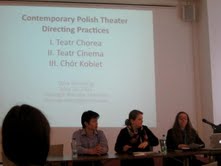
Here’s my abstract for the paper:

This presentation will broadly characterize some elements of contemporary Polish theater directing practices. Case studies will include Warsaw’s Chór Kobiet (Chorus of Women), Teatr Cinema Michałowice, and Łódź’s Teatr Chorea–one of the group of Polish theaters with a historic connection to director Jerzy Grotowski. These theaters will be examined with regard to their rehearsal processes, ensemble work, improvisation, use of text, and use of theatrical forms resembling Greek choruses. The conclusion will reflect on how some Polish theater directing practices might be applicable or useful to practitioners outside Poland.

The proceedings of our conference are going to be published this summer, so I won’t quote the paper any further here.

After the graduation ceremony (and receiving diplomas) at the Ambassador’s house on Friday, we then headed back to the Fulbright Commission’s offices on Nowy Świat for our end-of-year meeting. There was a great surprise for those of us renewing; we were able to sign and turn in our renewal paperwork at that time. It felt very good to see the paperwork for next year’s grant. As one of the other Fulbrighters was saying, in the offices, “This isn’t the end; this is just the beginning of the beginning.”

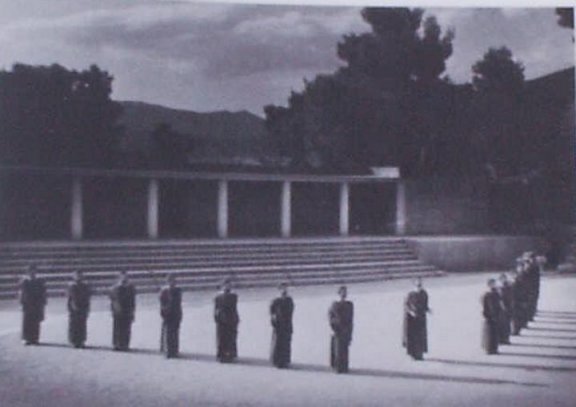
It’s been a fantastic year here in Poland, and it’s not over yet. These last weeks have been full of culminations and much-welcome houseguests and visitors and exhibitions and performances as the year wraps up. (Somewhere in the middle of all this, Chorea’s Bachantki also performed two more times, in Łódź, and I got to sing in the choir again.)

In addition, I’m presenting a sort of performance myself, another reading, on June 3rd, which will be a real culmination for me–my first time directing something public in Poland, after so much time spent analyzing the work here. About which more, very shortly.
Standard
Uncategorized

Theatre Is Not A Commodity, and this blog is not dead…not yet.

I have a new article online in the latest issue of Biweekly.pl. It’s about the “Teatr nie jest produktem…” protests that occurred during the March Warsaw Theatre Meetings, concurrently with the visits of a group of playwrights from USC.

Here’s the first paragraph:

In March, just before the spring 2012 Warszawskie Spotkania Teatralne (The Warsaw Theatre Meetings, hereafter referred to as the WST), a group of Polish theatre artists, critics and scholars organises a public letter of protest. They’re enraged by recent actions of the local government of Lower Silesia, the region including Wrocław, Legnica and Wałbrzych – specifically, a short-lived effort to institute a business manager who would be able to overrule decisions made by artistic directors of theatres. Some recent cuts to state funding for theatre are also a concern. The protest slogan: “Teatr nie jest firmą/nie jest produktem, widz nie jest klientem.” (The theatre is not a corporation or a commodity – spectators are not customers). “TEATR NIE JEST PRODUKTEM” buttons appear on the backpacks of the festival-goers.

You can read the whole thing here.

This article, which I didn’t write until a month or so after the events, is a good example of why I’ve been having such a hard time blogging lately. While these events were going on, it seemed to me that it might be a good idea to write a blog post about them–that people would want to hear about them. I didn’t do it.

But then, in talking with the Biweekly editor, the idea for this piece came up. As a result, I got to write something longer and better, with photos and with some very serious and helpful editing from Polish theatre experts, than I ever would have done over here. That was good.

But there are other equally interesting series of events that have taken place recently, that I’ve been part of, that I’ve never written anything about — blog or proper article. That’s not so good.

One thing I am doing is keeping an enormous Word document sort of journal, which I write in as if it was a blog, without publishing it online. Then when these articles come up, I can go back to it. It’s quite long now. I am hoping it will be long enough for something longer than an article in the future. (Recently, when I left my laptop in the Nowy Wspaniały Świat cafe, this document was what I was kicking myself the most for losing. I retrieved the laptop about an hour later.)

Standard
Uncategorized

Happy Majówka Newsflash

It seems a good time, as Poland enters this holiday week, to say over here what I’ve already said on Facebook:

(1) the Fulbright Commission granted me a renewal, which means a second year of funding to stay in Poland, live in Łódź, and keep working with Teatr Chorea from fall 2012-summer 2013, and;

(2) fellow 2011-2012 Poland Fulbrighter Douglas Pew and I have been selected for one of the three inaugural 20-minute opera commissions in the first year of the Washington National Opera / Kennedy Center’s American Opera Initiative.

The short opera we’re going to write will premiere, along with the other two, on November 19, 2012 at the Terrace Theater at the Kennedy Center in DC. I will post more details up here when I have them.

These people have opera glasses, because they are at the opera.

I am very grateful for both these things. I’ve been very fortunate, and I couldn’t have done any of this without a great deal of support from other people. I want to say thank you, here and always, to everyone who’s helped me to get to this point. The only appropriate response seems to be this Belle and Sebastian song, “Dirty Dream Number Two,” with these opening lyrics:

I’m lucky I can open the door and I can walk down the street;
I’m lucky I’ve got no place to go, and so I follow my feet…

It’s always reminded me more than a little of “Tangled Up In Blue.” You never know when good things are going to happen, or bad things, or things, at all. You just have to go for the ride, and there’s no knowing how long it’s going to last. Thanks for coming along with me–for today, tomorrow, we’ll be back in trouble again.

Standard