yes: that was a drastic redesign.
yes: there is now a static front page.
yes: and I’ve finally started adding content to the “the chorus” section, and a table of contents, which makes me hopeful that I will put in documentation of all the old projects, like ellie harrison has on her site
yes: it is now 4 AM.
yes: I should put my teaching portfolio up here too.
yes: my parents and Z&P are visiting every museum in San Jose at this moment
yes: still in Poland
yes: at one point I was trying to do something more complicated with CSS and failed
Category Archives: Uncategorized
a nice ornery essay
If there is no method of work that we can rely on, maybe at least we can encourage in ourselves a temperament that is not easily satisfied. Sometime when we are discouraged with our own work, we may notice that even the great poems, the sources and the standards, seem inadequate: “Ode to a Nightingale” feels too limited in scope, “Out of the Cradle” too sloppy, “To His Coy Mistress” too neat, and “Among Schoolchildren” padded. . . .
Maybe ambition is appropriately unattainable when we acknowledge: No poem is so great as we demand that poetry be.
– Donald Hall, “Poetry and Ambition.” He says many things with which I do not agree, including some standard MFA-disparaging remarks, but it’s an interesting essay and if I was still teaching creative writing I would assign it.
on a more inspiring note (“There are no vampires in this novel”)
Let’s change the subject. One novelist’s advice for when you feel confused, while writing:
If you’ve ever traveled, you know what it’s like to be totally lost and slightly panicked because you don’t believe you have the skills (language, a good map, lots of money) to find the place where you think you need to be. The thing you don’t do, is sit on a street corner and wait for the place to come to you. You know that will never happen. Instead, you start walking.
– Jessica Blau, author of The Summer of Naked Swim Parties and Drinking Closer to Home, as part of the Writer’s Digest “7 Things I’ve Learned So Far” series.
I’m not going to keep ranting about how much I hated a certain movie (see previous post): but I will say that the review of DCtH I’ve linked to, in the Nervous Breakdown, does make this astute observation: “There are no vampires in this novel, no portals to other worlds, or crimes to be solved, nothing to prop up the narrative except truth, and emotion, and love.”
half a league, half a league
Posting has been light, due to extreme theatregoing. Over the past few days, I saw NOSFERATU at Teatr Narodowy three times in one weekend (I’ve never done this before for a show I wasn’t working on–very, very interesting experience, still processing it…), NASZA KLASA at Teatr Na Woli, and CK’s MAGNIFICAT at the Instytut Teatralny, as well as a couple of films in the Jewish Film Festival.
Articles, articles, articles, articles, articles in progress. If this continues, I, like Keats in Byron’s posthumous slur, will be “snuffed out by an article.” Just kidding. I’m really enjoying having the chance to do so much writing, and to use some of the rusty old wrenches from the critical toolbox that I haven’t really used since the good old days at LAist.
Wednesday, I spent some time at the Nowy Wspanialy Swiat café talking with a translator for a number of Polish plays–it was really interesting to have the chance to discuss his work with him. He’s also involved in projects such as supertitles and translating at festivals. One cool thing I got to do for him that I can share was make a list of war poems in English that he could scour through for a one-line analog to a famous line from a Polish war poem (Mickiewicz’s “Reduta Ordona”–the line, in English is something roughly like “We were not given the order to fire.”) Poetry and theater: “it’s complicated,” since before 2400 BCE.
The Russian Film Festival started yesterday, just in case you thought there wasn’t enough going on around here.
I am saddened by the OWS encampments being torn down, in NYC and elsewhere. I know this isn’t going to be the end of the movement, or of the issues it raised, but I do hope it’s not really the end of the physical manifestation of the protesters’ camps. I’ve read so many interesting articles over the past few weeks about what they’re doing, and the human interactions occurring at these camps, and it just seems like a remarkably positive-intentioned movement, to sound like a Californian (which I am). I’m proud of everyone I know who’s been involved with OWS in all the various cities.
I am happy that the new Muppet movie is coming out soon, although it won’t come out so soon here–but that feels like a remarkably trivial observation, given the previous one. I would also be lying if I said I wasn’t excited about today being the premiere of Zmierzch: Przed świtem; Część 1, if only for the many opportunities to try to pronounce “Zmierzch.”
My inbox bristles with political emails. “Dara–are you on the right side of history?” “Dara–can we count on you?” OWS in danger. Internet freedom under attack in Congress. My Gmail is turning into the bearer of bad news. And in my own small wheelhouse / cabin / dugout / metaphor, Arena Stage has to pull a production, on the heels of the Funny Girl revival being canceled, on the heels of one of my favorite theaters in the world (TJT) closing its doors. Oh, ArtsJournal, bring me some good news. Please.
It’s a good time to be in Europe, but my thoughts are with my friends at home who are still trying–to keep their jobs, to make art, to protect our civil liberties, including the right to assembly, and slow the further collapse of the economy.
Another chór kobiet article
My Biweekly.pl article about Chór Kobiet (Warsaw’s Chorus of Women) is now online. (Biweekly.pl is the English-language side of a Polish arts magazine and website, dwutygodnik.com.) Here’s a paragraph from the article:
In Polish theatre, forms and elements resembling Greek choruses are not unheard of. Grotowski and Kantor both experimented with choruses; Polish companies inspired, in part, by one or the other of those directors, such as Wrocław’s Teatr Pieśń Kozła, Łódź’s Chorea, Michałowice’s Teatr Cinema, and others, follow suit. However, even in this chorus-conscious context, it is still a remarkable feat that Górnicka was able to sustain an hour-long chorus of almost thirty performers, speaking comprehensible text, as the central element of a theatrical performance. I wanted to find out more about her methods.
You can read the whole thing here.
Riots in Plac Konstytucji yesterday
So, yesterday, when I was writing my article, going to the synagogue for the Independence Day “prayers for Poland,” and having dinner with a friend, this was happening, too.
Twenty nine people, including several policemen, were taken to the hospital with injuries and two hundred people were arrested as result of clashes between police and right-wing extremists during events held in Warsaw, November 11, to commemorate Poland’s Independence Day.
I didn’t observe this first-hand, and neither did anyone I know. My friends who showed up earlier in the day to support the anti-fascist parade ended up leaving because things were already starting to seem unsafe.
They said that there was an extremely large turnout of people supporting the anti-fascists–people with rainbow flags, one person wearing the poster of this weekend’s Jewish Film Festival. They wanted to stay and support, but they were starting to become frightened by the enormous number of police. My friend made it sound like there was a very large group of anti-fascists, a circle of police trying to protect the anti-fascists, and a small number of determined pro-fascists trying to break through the circle of police. Again, I wasn’t there, but this is what my friends experienced.
Plac Konstytucji is right around the corner from the hostel I was staying in when I first came to Poland, and it’s the first place outside the airport I saw that I really associate with Warsaw. I can’t imagine there being riots there. It’s right in the center of town.
For another thing, Poland is–and has been for as long as I’ve been coming here–one of the most peaceful, quiet, friendly, welcoming places I’ve ever seen. It’s impossible for me to imagine what this was like.
I’m grateful to all the Varsovians who showed up to support the anti-fascist parade, sorry that some of them got hurt, and I’m saddened that Poland’s independence day–which, as President Komorowski said, should be a time to celebrate together, “not against one another”–was marred by the actions of this small right-wing extremist group, who are entirely out of touch with the spirit of today’s Poland.
Narodowe Święto Niepodległości
Today is Poland’s National Independence Day. I and another Jewish Fulbrighter are going to a synagogue this afternoon, where there will be a special service of “prayers for Poland” before the regular Shabbat services. I just have to finish proofreading this article first.
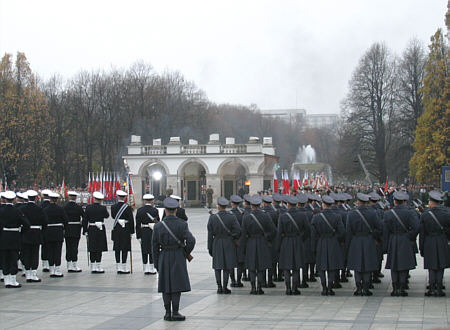
Attribution: Wikimedia Commons. That's the Tomb of the Unknown Soldier in the background, here in Warsaw..
Here’s the beginning of Wikipedia’s explanation of the holiday, which I have shortened a bit for this blog, and why on it’s November 11. I do not wish to in any way soften the enthusiastic tone of the article. There are so many memorials, both in the calendar and around the country, to times of great suffering; this is one of the celebrations.
National Independence Day (Polish: Narodowe Święto Niepodległości) is a public holiday in Poland celebrated every year on 11 November to commemorate the anniversary of Poland’s assumption of independent statehood in 1918 after 123 years of partition by Russia, Prussia and Austria.
[…]
Autumn 1918 marked the end of World War I and the defeat of all three occupiers. Russia was plunged into the confusion of revolution and civil war, the multinational Austro-Hungarian monarchy fell apart and went into decline and the Germans bowed to pressure from the forces of the Entente.
For Poles this was a unique opportunity to reclaim their national way of life. Following defeat of the occupying forces, the Poles began to seize military and civil power, building the foundations of their future nation.
[…]
On the nights of 6 and 7 November the Provisional Government of the People’s Republic of Poland was formed in Lublin under the supervision of Ignacy Daszyński.
[…]
…Józef Pilsudski returned to Poland. He had been imprisoned since July 1917 by the Germans. On 10 November 1918 he arrived in Warsaw. His arrival was enthusiastically met by the population of the capital and saw the mass disarmament of the occupying forces across the whole of Poland.
On 11 November 1918 the secret departments of the Polish Military Organisation, demobilized soldiers, legionnaires and young people, disarmed the Germans in Warsaw and other Polish towns. The Regency Government appointed Józef Pilsudski Commander-in-Chief over the Polish Forces and three days later Pilsudski was given complete civil control.
[…]
After World War II the Polish People’s authorities removed Independence Day from the calendar but the reclamation of independence continued to be celebrated commonly on 11 November. In 1989 the 9th term of the Sejm government restored the official holiday.
Hello, November.
Yesterday morning, a misty fog was hanging low to the ground, over the leafless trees, the trams, and the church spires–the first such fog I’ve seen since coming here. The fog thinned a bit, and isn’t so low now, but the cloud layer hasn’t gone away. The skies are gray and the air is uncomfortably cold. It is no longer pleasant to be outside. This is, I think, the beginning of the real Polish winter, and the end of the blue sky, for the present.
But I don’t mind. Really. I’ve had a wonderful couple of days. I’ve been working on a shiny new Polish theater article (more on that very soon), I conducted an interview with a very, very interesting director on Wednesday, my Polish class is going well, and I’ve been doing much better about socializing with the other Fulbrighters. I’ve been making laptop work dates to go places and get stuff done. It’s been good; lots of writing has happened. Writing is always a lonely occupation, but sometimes you can be more effectively lonely in the company of other simultaneously lonely writers.
Tomorrow, a friend of mine whose field here is Jewish studies and history is going to go with me to services at the synagogue. These aren’t my first Jewish services in Poland–I’ve been in Wroclaw, two years ago, with T.–but it will be my first time in Warsaw. There’s also a Jewish Film Festival this weekend, and we’re going to try to see some of the screenings.
Polish theater article in AMERICAN THEATRE
A short article I wrote about chór kobiet is now in the Global Spotlight section of the November issue of American Theatre. The article won’t be posted online, but you can download a PDF of it by clicking here–or find it in the current issue of the magazine. The article’s title is “Poland’s Chorus of Women Hits the Road.” It’s the second article in a group of three in the PDF.
Here’s a video, for anyone who has yet to experience the greatness that is chór kobiet. With English subtitles!
Poproszę pstrąg.
Getting colder: the Varsoviennes have all decided it’s time to be wearing wool shrug/scarf things. Today: second Polish yoga class (slow, slow, hard-work Iyengar); picked up tickets from two different theatres for three different plays this week and weekend; another walk in the Saxon Gardens, where the previously noted profusion of fallen leaves from yesterday was being painstakingly raked into rows to be removed; study for Polish vocabulary test at the BUW; Polish vocabulary test; dinner with friends from Polish class at a restaurant in Plac Konstytucji, where I ordered a trout in celebration of knowing how to say the word for “trout” in Polish. (“Pstrąg,” if you were wondering.) No matter what you call it, it still has a lot of tiny bones in it. Tomorrow, I have an interview, a play, and probably at least one more moment of wide-spindrift-sealesque contemplating the fallen leaves while they are still there to be contemplated.
 Dara Weinberg