Uncategorized

Lublin bound

“The summer was in full bloom. The fields grew golden, fruit ripened in the orchards. Intoxicating earth aromas induced lassitude and an ethereal calm. ”Oh God Almighty, You are the magician, not I!” Yasha whispered. ”To bring out plants, flowers and colors from a bit of black soil!”

The Magician of Lublin, Isaac Bashevis Singer (as quoted in NYT review here)

I’ll be in Lublin in about 3 hours–that, to me, is about as exciting as saying “I’ll be in the Emerald City of Oz in 3 hours.” Of course, it’s not going to be the summertime Yasha was talking about, but I’m still expecting it to be beautiful.

To be continued.

Standard
Uncategorized

Crossing the Vistula

On Saturday at around 17:00, heading into the center of town for a meeting, there were fewer people than usual on the tram car. I decided this was my chance to shoot a short video of the trip over the Vistula on Most Gdański, going from the east bank to the west. It’s a little over a minute long. It starts when we’re stopped on the Praga side, at the Wybreże Helskie stop, and finishes as we come to the Most Gdański stop. The camera is looking south, downriver.

The next day, coming back from another meeting, I decided to walk across the bridge–in the opposite direction–while it was still warm enough to do so (barely.) It was very, very, very cold. I won’t be doing this again until the spring. I tried to count my steps, but forgot about it after about a hundred. I think that it’s at least 300 steps (for me) to walk across the river.

Today, I’m making preparations for an interview this afternoon and a trip to Lublin tomorrow, to see the Berliner Compagnie–who I worked with way back in 2003–perform as part of a festival. It will be wonderful to see them again. It has been too long. In addition, I’ve had a Lublin obsession since I read Isaac Bashevis Singer’s novel The Magician of Lublin when I was a teenager. It’s still one of my favorites of his books. The only city in Poland I’m more excited about seeing for the first time is Kraków. (Trumpeter of. Children’s book.)

I’ll be in Lublin for two days, back in Warsaw for about 24 hours, and then head to Wrocław for the weekend for another performance. October’s been a fun month.

Standard
Uncategorized

First 24 hours in Warsaw

Almost two months delayed, here are some of the pictures I took when I arrived in Warsaw, on August 20 and 21. I’m going to be doing some photo catch-up over the next few days. I have many, many, many more pictures.

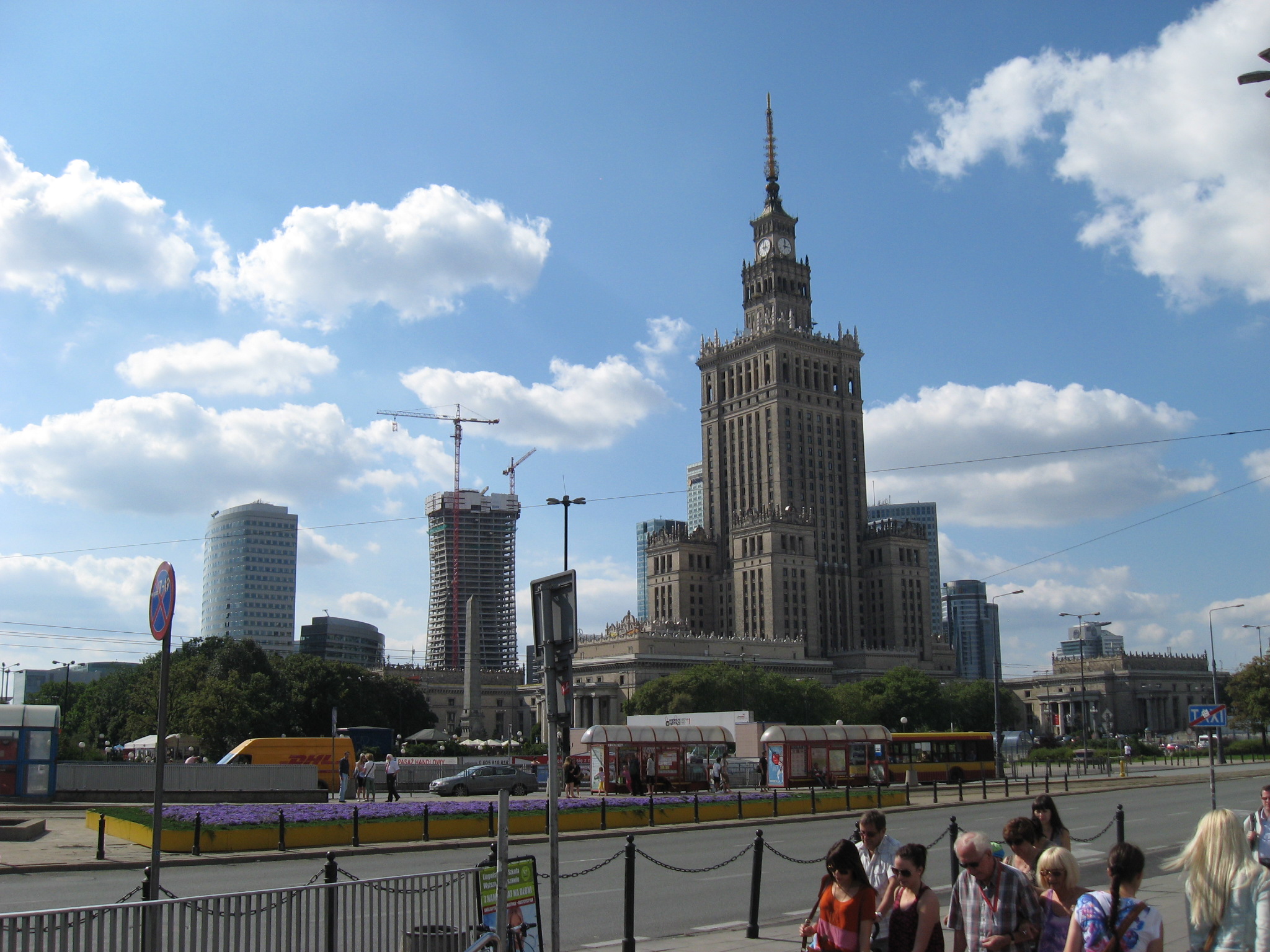
Ul. Marszałkowska and the Pałac Kultury i Nauki on a sunny August day. Don't those clouds look like summer Chicago clouds?

In this gallery mode, you should be able to click on one of the pictures and then go through them in a slideshow.

Standard
Poland

the new emotions that time brings

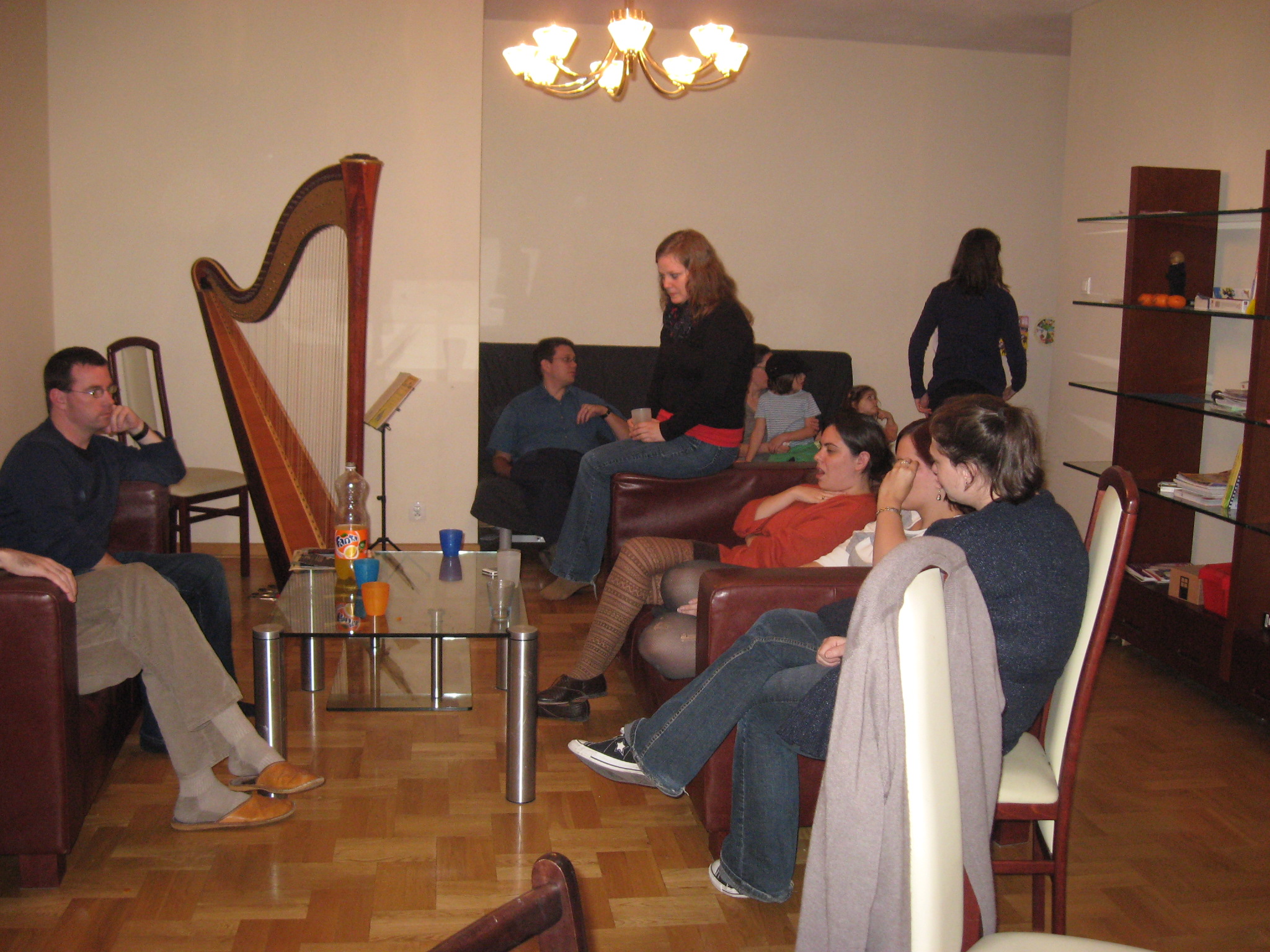
Very successful Warsaw Fulbrighter potluck yesterday. I spent the morning shopping, the afternoon cooking, and the evening eating. The hostess played her rented Russian harp, and we sang “Somewhere Over the Rainbow” and “Greensleeves.”

Fulbrighter potluck, with harp!

I made potstickers (and wrappers), a vegetarian tofu/kapusta/szpinak stir-fry, and Nigella’s pistachio fudge, modified with cashews and coconuts. Others made barszcz, salad, peach cobbler, and pączki.

I CAN HAZ POTSTICKERS

It was great to all be gathered together again after not seeing each other en masse since orientation.

There were Fulbrighter children at the party, which was really nice. A break in the age-isolation chamber of theater/academia. Some of them are attending Polish schools, despite not having known any Polish before they arrived. One of them is at a sports-oriented elementary, and she told us that, last week, the girls had to run 100 laps of the gym, and the boys 110. If my memory of the fourth grade serves, we never did anything quite that hard-core.

Plans were made to go see the Battle of Warsaw film together, z napisami angielskimi. Also, scheming was commenced for Thanksgiving. I may or may not have told a vegetarian Fulbrighter that I could totally figure out how to make a tofurkey from scratch. I have a memory of saying “There must have been a time when some vegan chick had to do it herself, and that was the first tofurkey.” Foot, mouth, etc.

Roll call (and more food pictures):

Continue reading

Standard
Poland

czwartek

Today was a checklist kind of Thursday. Getting things done. All day at the Bibilioteka Uniwersytecka w Warszawie. Wrote and sent off long-delayed article about Polish theater director. Studied for tense on the present tense; took, and survived, test on the present tense. A productive day, and I feel completely justified in doing nothing tomorrow except cooking.

Consequently, I went on a late-night shopping expedition to the Arkadia Carrefour, to get ingredients for potstickers, wrappers, and Nigella Lawson’s pistachio fudge* (and some lightweight plastic bowls, plates, forks, spoons, knives and cups) all for tomorrow’s Warsaw Fulbrighter potluck.

Ingredients I forgot that must be returned for tomorrow: tofu for the vegetarian version of the potstickers, sweetened condensed milk for the fudge, and sesame oil because it is my favorite ingredient of all time, and even though it is possible to make the potstickers without it, why would you?

Oh, and Julian Barnes won the Booker.

I feel as if I have arrived in Poland. I don’t know how this happened, or why it happened today as opposed to any other day in particular–but I feel, now more than before, that I’m here.

Standard
Poland

Poland and Iran

Yesterday, after Polish class, I took the 503 bus south and attended a party with a bunch of Polish diplomats, economic policy and arts/culture policy folks, at the invitation of my Extraordinarily Cool Roommate.

One of them asked me to say something about the increased presence of “vulgarity” in contemporary Polish theater, by which he meant all the sex. I was entirely unable to answer this question–“vulgarity” for me means theater that’s polluted with commercialism, not anything having to do with sex or violence. Polish theater’s absence of overt commercialism makes it, for me, the opposite of “vulgar.” In fact, with the staircase spirit of tomorrow’s response to yesterday’s question, I would characterize it as leaning toward the sacred, and suggest that the profanity is often presented in service of the sacred.

Yes, some Polish theater I’ve seen does throw in too much sex, violence, and violent sex–it can become somewhat humorous at times–but I have never felt that this gesture was out of box-office concerns as much as that Polish-theater tendency towards extremes at all costs. It doesn’t strike me as vulgar as much as (occasionally) misguided in enthusiasm. And it doesn’t happen in every production. I tried to explain how I feel about all this, but I don’t think I satisfied him.

Basically, it’s hard for me to be cognizant of small changes in the Polish theater landscape, such as–for example–more sex onstage in the last few years than in the previous few years–because the overall contrast between what I see here and what I saw at home is so great that these minute distinctions don’t seem as important. Perhaps, if I were a regular observer of the scene, I’d be able to respond to his comment. But I’m not. I’m an outsider, and the grass looks greener here, and that’s as far as I can go. At the moment.

I asked another group of people how often they saw theater. “Not often. Five times a year.” Five times a year! Five times a year is very often, I said, where I come from. “Not for Warsaw.”

A number of them had just gotten back from a trip to Iran (more of the activities relating to the Polish EU presidency) and they shared pictures of Tehran, Persepolis, and more.

It was the first time I had seen so many pictures of Iran, in such short succession–all enlarged and projected on a wall–and I was fascinated. I’d really like to visit the country someday. Some of the mountains, the plants, and even the color of the sky were downright desert-Californian. And the Persepolis site has stone ruins in it that look too large to be real.

There were also pictures of the anti-Israel propaganda posters that the government has on the subway in Tehran. There is something shocking about great graphic design being used for anti-ethnic statements. The images were so polished, so clean, so professional-looking. They were like Apple design posters. A Star of David in dust on the floor, being swept up by a broom. A swastika inscribed in the star (talk about a disturbing image for a room full of Polish diplomats in Warsaw…) And one, so over-the-top as to be ridiculous–out of a SNL sketch about Nazis or something–Stars of David on a roll of toilet paper.

I don’t want to overemphasize this point. There were hundreds of slides of beautiful landscapes in Iran, of families and children, of people praying, of people selling herbs and beans and plants in a market, of mosques and mosaics and bas-relief stone carvings and ancient stone columns and some of the most gorgeous mountains and canyons I’d ever seen. Polish diplomats having dinner with friends in Iran, posing in front of blue-tiled fountains and jagged hills.

All in all, the posters seemed altogether out of context with all the other images of this beautiful, hospitable, picturesque country. Except for one sequence. There were also pictures from a protest in what the Polish diplomats said was a more conservative neighborhood–angry protesters holding “Down with USA” signs (in English as well as Farsi–all these signs and posters had English translations on them). One of the diplomats said that the translation was inaccurate–that the Farsi said “Death to the USA,” not “Down with.”

My favorite picture from this series was of a little boy with his head leaning on a “Death to the USA” sign, half-asleep. It was very ambiguous. It looked as if he didn’t really care about the protests.

Iran must be a complicated place to be in now. I would really like to see it for myself, some day.

Took a taxi home. (First time doing that in Warsaw, too.)

To change the subject (let’s)–this morning, I uploaded a whole bunch of new Parallel Octave sound files onto the site. You can listen here. Gertrude Stein, Swinburne, Blake, Whitman, and (of course) another version of Emperor of Ice-Cream. I’m so proud of what the group is doing. I miss them. I must try to have some kind of similar thing happen here in Poland, at some point.

Next Baltimore ParOct session this Sunday from 1-2:30 pm. More Gertrude Stein and some Amy Lowell.

And right now, I’m writing, at home, on a laptop, and having one of those Calvin and Hobbes moments where you try to convince one fly to fly out the window and another three come in. Scheduling interviews. Planning for a potluck with friends on Friday. In the hallway, my roommate’s father affixes new glass panels to a door. A tranquil existence. A very calm Wednesday. An ordinary day in Warsaw.

Let’s let Julian Barnes have the last word. In case you hadn’t guessed, I’m going through the book (much easier to do this in a Kindle-for-Mac version) and posting my favorite passages. But this one is oddly appropriate to this post’s discussion, and it has a variation on that Greek messenger speech “And only I have escaped to tell you” line.

A while ago, I volunteered to run the library at the local hospital; I go round the wards delivering, collecting, recommending. It gets me out, and it’s good to do something useful; also, I meet some new people. Sick people, of course; dying people as well. But at least I shall know my way around the hospital when my turn comes.

And that’s a life, isn’t it? Some achievements and some disappointments. It’s been interesting to me, though I wouldn’t complain or be amazed if others found it less so. Maybe, in a way, Adrian knew what he was doing. Not that I would have missed my own life for anything, you understand.

I survived. “He survived to tell the tale”—that’s what people say, don’t they? History isn’t the lies of the victors, as I once glibly assured Old Joe Hunt; I know that now. It’s more the memories of the survivors, most of whom are neither victorious nor defeated.

– Julian Barnes, The Sense of an Ending (2011)
Standard
Poland, theater

Of course we were pretentious–what is youth for?

Off to the university library for some Polish class homework. One of the pleasures of a new city is navigating the different routes to your destination; I’m not at the point yet that I know the best routes from hither to thither, so I try new buses and things. The 118, the 503, the 105, the 128…

The library has a cafe on the ground level where you can get a cup of tea for 4 PLN and a bowl of soup for 5. (Again, divide by 3 for USD.) I’ll camp out there and do review homework until class this evening.

This morning, organizing logistics for some upcoming interviews with people, and realizing my October and November are getting quite full. In the next four weeks, I’ll be going to Wroclaw twice, Krakow once, and Lublin once. I was trying to make a list of available evenings in Warsaw when I could conduct an interview, and was surprised to only have a handful of them.

Later tonight, I’m going to go to a party at the house of a friend of a friend, in a hitherto-unvisited neighborhood, near the Muranow metro stop.

Julian Barnes wants to take over for a bit here:

Of course we were pretentious—what else is youth for? We used terms like “Weltanschauung” and “Sturm und Drang,” enjoyed saying “That’s philosophically self-evident,” and assured one another that the imagination’s first duty was to be transgressive. Our parents saw things differently, picturing their children as innocents suddenly exposed to noxious influence. So Colin’s mother referred to me as his “dark angel”; my father blamed Alex when he found me reading The Communist Manifesto; Colin was fingered by Alex’s parents when they caught him with a hard-boiled American crime novel. And so on. It was the same with sex. Our parents thought we might be corrupted by one another into becoming whatever it was they most feared: an incorrigible masturbator, a winsome homosexual, a recklessly impregnatory libertine. On our behalf they dreaded the closeness of adolescent friendship, the predatory behaviour of strangers on trains, the lure of the wrong kind of girl. How far their anxieties outran our experience.

– Julian Barnes, The Sense of an Ending (2011)

This particular quote makes me realize there are some similarities in Barnes’s project in this book to that of Donna Tartt in The Secret History. Intellectual coming-of-age and corruption. But Barnes, unlike Tartt, leaves the young people behind quickly to go to looking back at them from the point of view of an older character.

There you have it. I really liked The Sense of an Ending. I could read the entire thing over again, right now.

Standard
Uncategorized

He liked to use contemporary texts

OK. Time to donate money to the Obama campaign again. Being abroad while all this electioneering is going on makes me feel nostalgic for, and protective of, the United States. I remember feeling the same way when I was in Germany in 2003. I keep writing emails to people saying things like “Keep Baltimore real for me,” but what I really want to say is, “Don’t let the Tea Party take over.” They’re at just under a million donors now–you can watch the counter go up.

What Would Julian Barnes Write, continued:

“Later that day—or perhaps another day—we had a double English period with Phil Dixon, a young master just down from Cambridge. He liked to use contemporary texts, and would throw out sudden challenges. “ ‘Birth, and Copulation, and Death’—that’s what T. S. Eliot says it’s all about. Any comments?” He once compared a Shakespearean hero to Kirk Douglas in Spartacus. And I remember how, when we were discussing Ted Hughes’s poetry, he put his head at a donnish slant and murmured, “Of course, we’re all wondering what will happen when he runs out of animals.” Sometimes, he addressed us as “Gentlemen.” Naturally, we adored him.”

– Julian Barnes, The Sense of an Ending (2011)

Standard
Uncategorized

be true to the impressions those facts left

The continued cold weather makes me want to cook. Today, I found out that the little conglomerate of shops and sheds which becomes a full flea/farmer’s market on weekends stays open on weekdays, too. Some of it. It’s very quiet. The shop owners sit outside their shops having cigarettes and chatting until a customer walks by. But there are fruit and vegetable stands, still.

Two rolls of paper towels: 2,90 PLN
Romaine lettuce: 2 PLN
A tremendous head of broccoli: 3 PLN
One kilogram of potatoes: 1 PLN

(Divide prices by 3 for USD.)

I took these, added hard-boiled eggs and a can of kidney beans. I made a dressing by roasting sunflower seeds with chilies in olive oil; the flavor made it seem like more of a taco salad than a nicoise. I steamed the broccoli over the potatoes while they were boiling, which made me feel as if things were being done efficiently.

The whole thing still took a long time, but I’m trying to be more Nigella Lawson in my attitude towards cooking. Relaxed, that is. I recently skimmed through How to Eat because it was released as a very inexpensive Kindle book, and I found it to be inspiring. Not that I followed any of the recipes, but in its attitudes. I probably wouldn’t have set out to make this salad in the first place without having read it.

After all this, I went to the Arkadia Carrefour to replace my roommate’s eggs and lemons, which I had used in making the salad, and was reminded how much I dislike really enormous supermarkets. Every time I’m in that Carrefour, I drop something and break it. Last time it was a glass bottle of carrot juice. This time it was an egg. It’s such a huge place, and there are so many people rushing down the aisles.

One of the nice things about being in Poland right now is the ability to choose between a faster-paced and a slower-paced way of living. They certainly have all the modern conveniences, including supermarkets larger than the Google campus, but they also still have the little stores that only sell one thing–bread, meat, fruit–if you want them. It’s nice to be able to have it both ways.

Roll call:

Oldfield Primary’s Jelly Toad: an old image, from part of the 2010 Larkin25 celebration of the poet’s death.

Two Hopkins poets have poems in the current Valparaiso Review: R. Tung and S. Lackaye. They were both second-years when I was a first-year.

Read Julian Barnes’s The Sense of an Ending today. I liked it more than I am capable of saying.

“We live in time—it holds us and moulds us—but I’ve never felt I understood it very well. And I’m not referring to theories about how it bends and doubles back, or may exist elsewhere in parallel versions. No, I mean ordinary, everyday time, which clocks and watches assure us passes regularly: tick-tock, click-clock. Is there anything more plausible than a second hand? And yet it takes only the smallest pleasure or pain to teach us time’s malleability. Some emotions speed it up, others slow it down; occasionally, it seems to go missing—until the eventual point when it really does go missing, never to return.

I’m not very interested in my schooldays, and don’t feel any nostalgia for them. But school is where it all began, so I need to return briefly to a few incidents that have grown into anecdotes, to some approximate memories which time has deformed into certainty. If I can’t be sure of the actual events any more, I can at least be true to the impressions those facts left. That’s the best I can manage.”

– Julian Barnes, The Sense of an Ending (2011)

Standard
Uncategorized

cold enough to complain

as of yesterday; the weather report on the TV in the Centrum metro station says it was 0 yesterday and -1 today. (Centigrade.) It feels like it’s time for hats and gloves.

Yesterday my roommate and I finished cleaning out the now-defrosted refrigerator. We were able to leave all the perishables on the balcony overnight, and they were fine, due to the above-cited temperatures.

Afterwards, I went to my first-ever Mass at the Praga Cathedral, to hear a friend’s choir sing selections during the service. The Mass was conducted in Polish, of course, but I was able to follow something about rendering unto Caesar what is Caesar’s.

The singers were wonderful, haunting and subtle; my friend D., who works with them, says that Polish choral singers have a remarkable ability to create a blended sound. This matches my experiences with Polish actors and choral voices in a theater context. I’m looking forward to hearing more Polish choral music in a classical setting, going forward.

And then, since it was the last night of the Warsaw Film Festival, a group of people met back at the Kinoteka at the Pałac Kultury i Nauki (PKN henceforth) to see a late screening of Paddy Considine’s film “Tyrannosaur.” Wonderful British actors, very dark plot about domestic and child abuse. Beautifully shot and acted–the lead actor, Peter Mullen, was unforgettable.

Here’s director Considine talking about the film–his first:

With its thugs with pitbulls, cocky youths in pubs, and secretly abusive Christians, Considine seems to have a very bleak vision of the world. “I never made Tyrannosaur to be a film about social realism,” he insisted. “Where they are is just where they are. The world it is set is a world I understood and I wanted to make a film about human beings in pain and a film about redemption and about soulmates – two people from different sides of society – and . I wanted to make a film about love.

article about Tyrannosaur, “Nothing prehistoric about contemporary love story,” Sheffield Telegraph

Standard