Uncategorized

Another chór kobiet article

My Biweekly.pl article about Chór Kobiet (Warsaw’s Chorus of Women) is now online. (Biweekly.pl is the English-language side of a Polish arts magazine and website, dwutygodnik.com.) Here’s a paragraph from the article:

In Polish theatre, forms and elements resembling Greek choruses are not unheard of. Grotowski and Kantor both experimented with choruses; Polish companies inspired, in part, by one or the other of those directors, such as Wrocław’s Teatr Pieśń Kozła, Łódź’s Chorea, Michałowice’s Teatr Cinema, and others, follow suit. However, even in this chorus-conscious context, it is still a remarkable feat that Górnicka was able to sustain an hour-long chorus of almost thirty performers, speaking comprehensible text, as the central element of a theatrical performance. I wanted to find out more about her methods.


You can read the whole thing here.

Standard
Uncategorized

Riots in Plac Konstytucji yesterday

So, yesterday, when I was writing my article, going to the synagogue for the Independence Day “prayers for Poland,” and having dinner with a friend, this was happening, too.

Twenty nine people, including several policemen, were taken to the hospital with injuries and two hundred people were arrested as result of clashes between police and right-wing extremists during events held in Warsaw, November 11, to commemorate Poland’s Independence Day.

Warsaw Voice

I didn’t observe this first-hand, and neither did anyone I know. My friends who showed up earlier in the day to support the anti-fascist parade ended up leaving because things were already starting to seem unsafe.

They said that there was an extremely large turnout of people supporting the anti-fascists–people with rainbow flags, one person wearing the poster of this weekend’s Jewish Film Festival. They wanted to stay and support, but they were starting to become frightened by the enormous number of police. My friend made it sound like there was a very large group of anti-fascists, a circle of police trying to protect the anti-fascists, and a small number of determined pro-fascists trying to break through the circle of police. Again, I wasn’t there, but this is what my friends experienced.

Plac Konstytucji is right around the corner from the hostel I was staying in when I first came to Poland, and it’s the first place outside the airport I saw that I really associate with Warsaw. I can’t imagine there being riots there. It’s right in the center of town.

For another thing, Poland is–and has been for as long as I’ve been coming here–one of the most peaceful, quiet, friendly, welcoming places I’ve ever seen. It’s impossible for me to imagine what this was like.

I’m grateful to all the Varsovians who showed up to support the anti-fascist parade, sorry that some of them got hurt, and I’m saddened that Poland’s independence day–which, as President Komorowski said, should be a time to celebrate together, “not against one another”–was marred by the actions of this small right-wing extremist group, who are entirely out of touch with the spirit of today’s Poland.

Standard
Uncategorized

Narodowe Święto Niepodległości

Today is Poland’s National Independence Day. I and another Jewish Fulbrighter are going to a synagogue this afternoon, where there will be a special service of “prayers for Poland” before the regular Shabbat services. I just have to finish proofreading this article first.

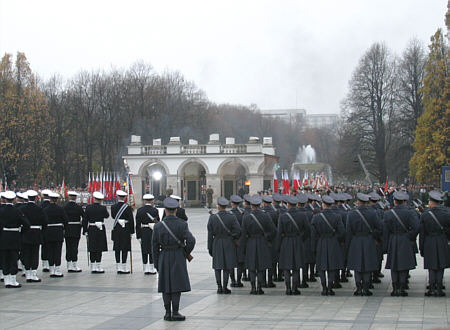
Attribution: Wikimedia Commons. That's the Tomb of the Unknown Soldier in the background, here in Warsaw..


Here’s the beginning of Wikipedia’s explanation of the holiday, which I have shortened a bit for this blog, and why on it’s November 11. I do not wish to in any way soften the enthusiastic tone of the article. There are so many memorials, both in the calendar and around the country, to times of great suffering; this is one of the celebrations.

National Independence Day (Polish: Narodowe Święto Niepodległości) is a public holiday in Poland celebrated every year on 11 November to commemorate the anniversary of Poland’s assumption of independent statehood in 1918 after 123 years of partition by Russia, Prussia and Austria.

[…]

Autumn 1918 marked the end of World War I and the defeat of all three occupiers. Russia was plunged into the confusion of revolution and civil war, the multinational Austro-Hungarian monarchy fell apart and went into decline and the Germans bowed to pressure from the forces of the Entente.

For Poles this was a unique opportunity to reclaim their national way of life. Following defeat of the occupying forces, the Poles began to seize military and civil power, building the foundations of their future nation.

[…]

On the nights of 6 and 7 November the Provisional Government of the People’s Republic of Poland was formed in Lublin under the supervision of Ignacy Daszyński.

[…]

…Józef Pilsudski returned to Poland. He had been imprisoned since July 1917 by the Germans. On 10 November 1918 he arrived in Warsaw. His arrival was enthusiastically met by the population of the capital and saw the mass disarmament of the occupying forces across the whole of Poland.

On 11 November 1918 the secret departments of the Polish Military Organisation, demobilized soldiers, legionnaires and young people, disarmed the Germans in Warsaw and other Polish towns. The Regency Government appointed Józef Pilsudski Commander-in-Chief over the Polish Forces and three days later Pilsudski was given complete civil control.

[…]

After World War II the Polish People’s authorities removed Independence Day from the calendar but the reclamation of independence continued to be celebrated commonly on 11 November. In 1989 the 9th term of the Sejm government restored the official holiday.

Standard
Uncategorized

Hello, November.

Yesterday morning, a misty fog was hanging low to the ground, over the leafless trees, the trams, and the church spires–the first such fog I’ve seen since coming here. The fog thinned a bit, and isn’t so low now, but the cloud layer hasn’t gone away. The skies are gray and the air is uncomfortably cold. It is no longer pleasant to be outside. This is, I think, the beginning of the real Polish winter, and the end of the blue sky, for the present.

But I don’t mind. Really. I’ve had a wonderful couple of days. I’ve been working on a shiny new Polish theater article (more on that very soon), I conducted an interview with a very, very interesting director on Wednesday, my Polish class is going well, and I’ve been doing much better about socializing with the other Fulbrighters. I’ve been making laptop work dates to go places and get stuff done. It’s been good; lots of writing has happened. Writing is always a lonely occupation, but sometimes you can be more effectively lonely in the company of other simultaneously lonely writers.

Tomorrow, a friend of mine whose field here is Jewish studies and history is going to go with me to services at the synagogue. These aren’t my first Jewish services in Poland–I’ve been in Wroclaw, two years ago, with T.–but it will be my first time in Warsaw. There’s also a Jewish Film Festival this weekend, and we’re going to try to see some of the screenings.

Continue reading

Standard
Uncategorized

Polish theater article in AMERICAN THEATRE

A short article I wrote about chór kobiet is now in the Global Spotlight section of the November issue of American Theatre. The article won’t be posted online, but you can download a PDF of it by clicking here–or find it in the current issue of the magazine. The article’s title is “Poland’s Chorus of Women Hits the Road.” It’s the second article in a group of three in the PDF.

Here’s a video, for anyone who has yet to experience the greatness that is chór kobiet. With English subtitles!

Standard
Uncategorized

Poproszę pstrąg.

Getting colder: the Varsoviennes have all decided it’s time to be wearing wool shrug/scarf things. Today: second Polish yoga class (slow, slow, hard-work Iyengar); picked up tickets from two different theatres for three different plays this week and weekend; another walk in the Saxon Gardens, where the previously noted profusion of fallen leaves from yesterday was being painstakingly raked into rows to be removed; study for Polish vocabulary test at the BUW; Polish vocabulary test; dinner with friends from Polish class at a restaurant in Plac Konstytucji, where I ordered a trout in celebration of knowing how to say the word for “trout” in Polish. (“Pstrąg,” if you were wondering.) No matter what you call it, it still has a lot of tiny bones in it. Tomorrow, I have an interview, a play, and probably at least one more moment of wide-spindrift-sealesque contemplating the fallen leaves while they are still there to be contemplated.

Standard
Uncategorized

First Polish yoga class today

I shouldn’t have waited so long to go. Yoga is yoga; even though I couldn’t understand everything, I was still able to take class, and it was lovely. In fact, I enjoyed feeling that I was communicating on another level than that of language. There were lots of interesting modifications using a folding chair, including a folding-chair-supported backbend.

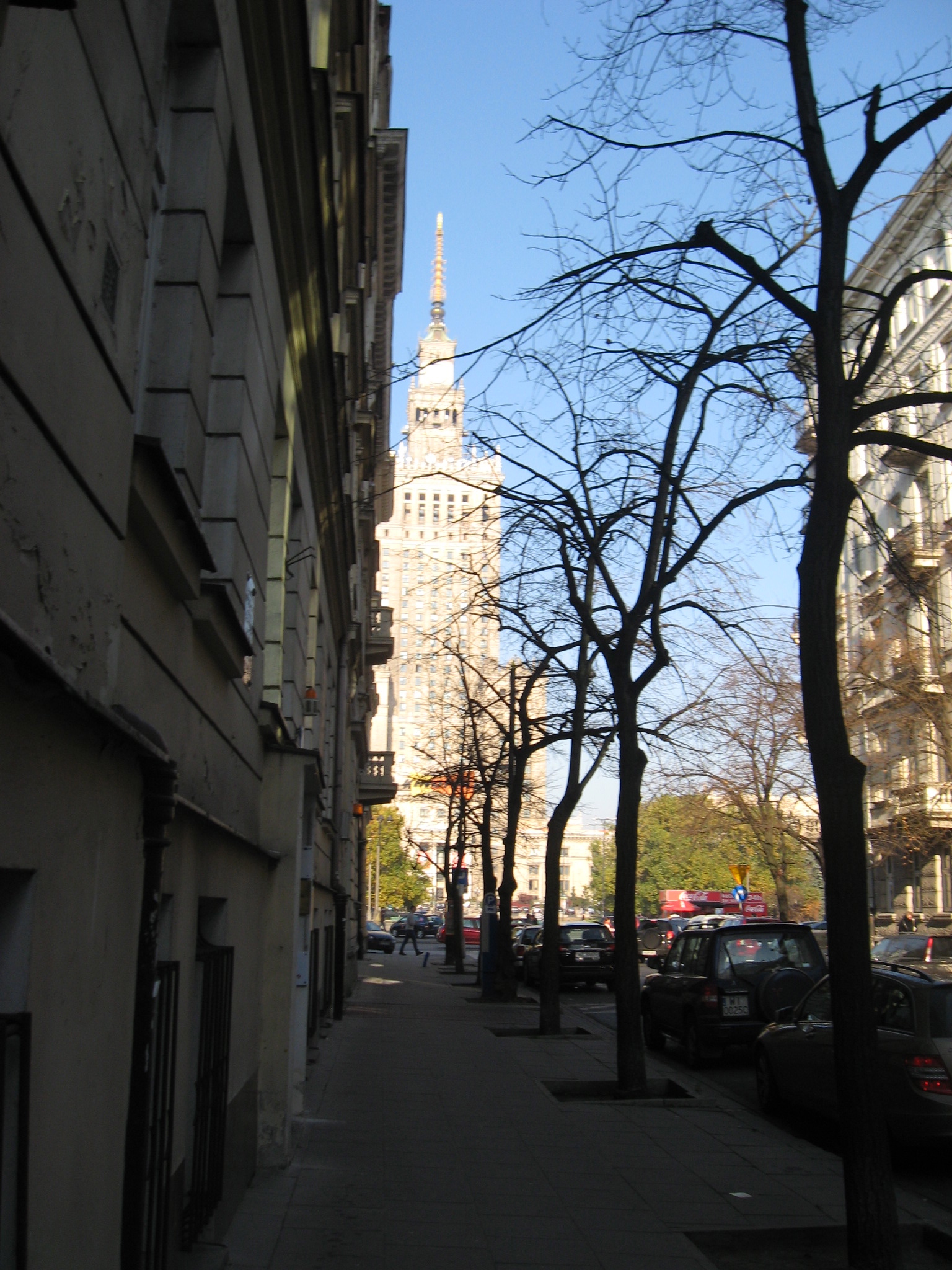
The view of the Pałac Kultury i Nauki, coming out of the studio after "joga."

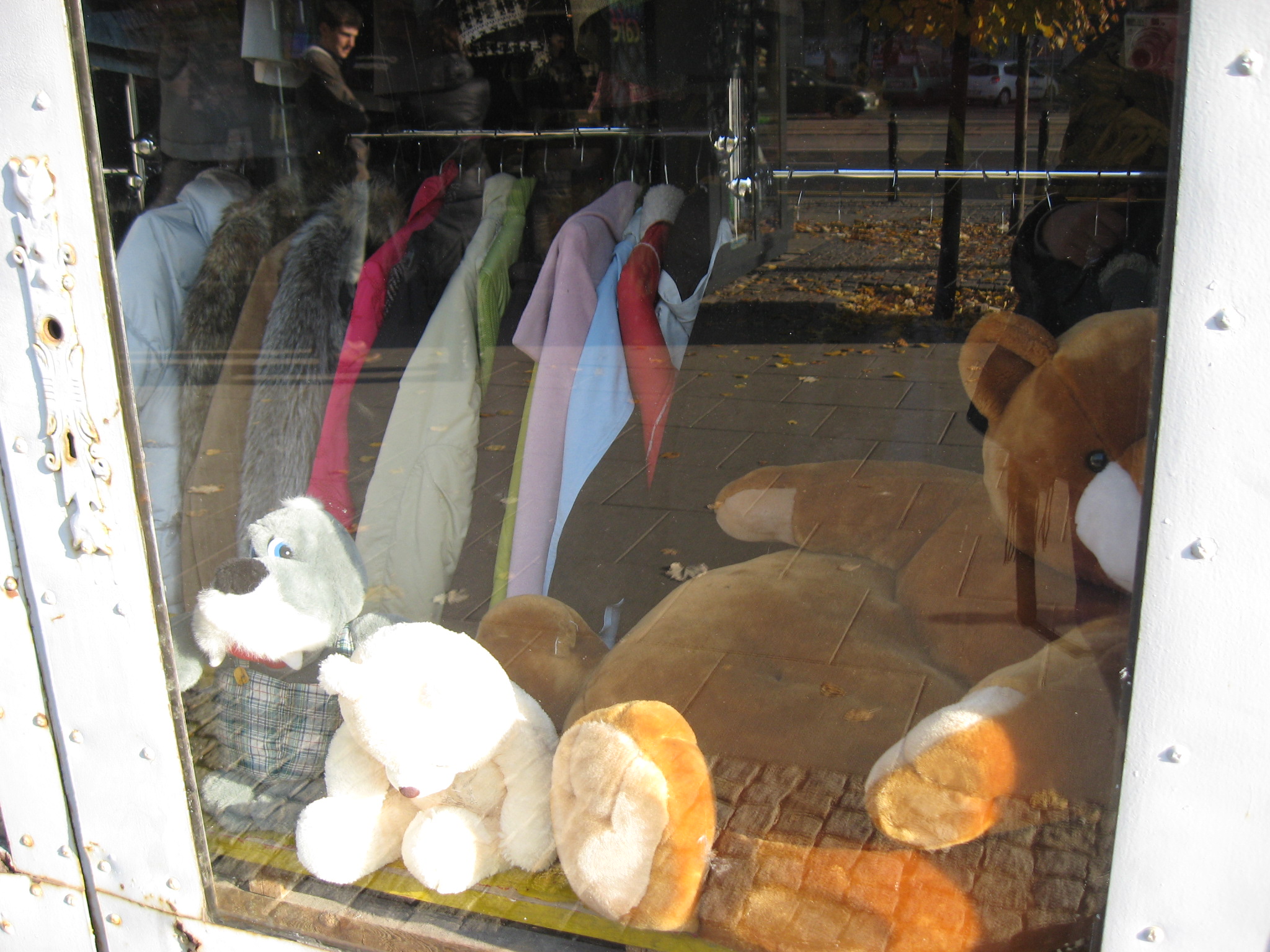
Afterwards, had a self-satisfied sandwich and scoped out the neighborhood where I’ve suggested that Z. and P. stay when they come to visit. On the way, saw these pathetically abandoned teddy bears in the window of a pay-by-the-weight thrift store.

Weep for what little things could make them glad.

After that moment of existentialism, I boarded the oncoming #4 tram, to head back north to Praga…

The #4 train in Plac Konstytucji.

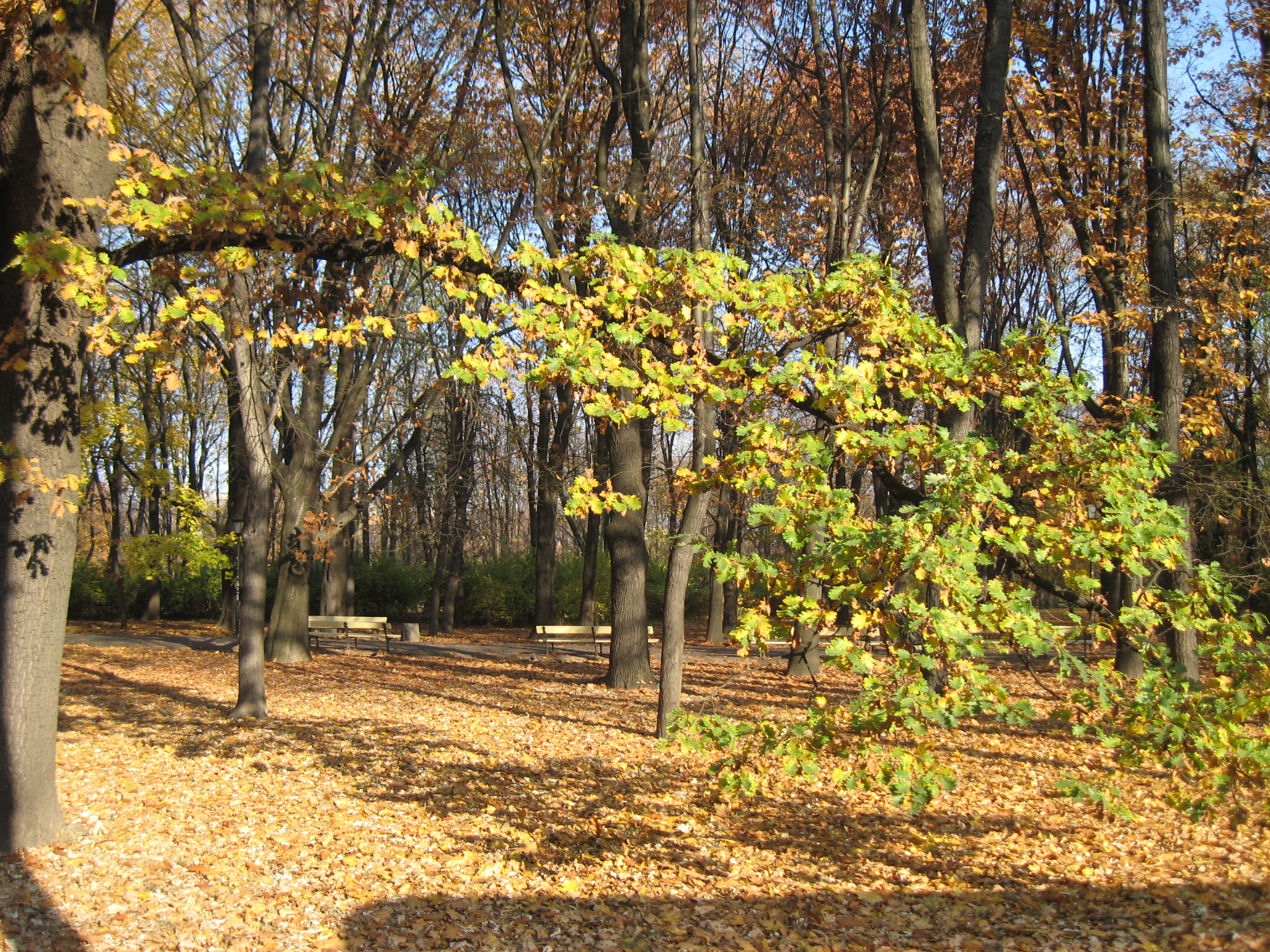
and got off again soon after, at Królewska, to walk in Saxon Gardens. People of all ages and dogs of all sorts enjoying the profusion of fallen leaves.

autumn autumn autumn autumn autumn

Returned, once back in the neighborhood, to the little stalls that still constitute the local market even when the full flea market isn’t in effect. Buying vegetables in yoga-induced haze. Pretty colors! Why is this cake in the bakery named “Zebra?” No, that was real…it’s a black-and-white cake…but it’s the sort of thing you only notice when your brain’s been flooded with too many endorphins.

Brokul: 3,50 PLN (“Brokul kontra kalafior“..!)
Pieprze i jabłka: 2,40 PLN

Afterwards, I made a Quizlet word set for my Polish vocab quiz tomorrow. It took me sixteen rounds to get all of them. Spelling kills me with Polish words–I’ll know the first letters, even what it sounds like, but be unable to put everything in the right order. I really like Quizlet’s features, though, and I’m hoping this will help me be more productive with vocabulary in the future.

My digital camera is dying; it takes two new batteries and then says “Please change batteries” three shots later. Considering this is the same digital camera I took to Germany in 2003, it’s done pretty well…I have eked a few last images out of it, as you see, including some fall leaves, but I think I will either have to revert to textual habits or else, you know, get a new one.

No, I did not see any theater today. I like to observe Mondays off even when not required to, I’m starting to realize. But I did confirm some arrangements for tickets next weekend, when I will be seeing six performances of three plays over five days. Because it’s Poland.
Standard
Uncategorized

Novembering

Farmer’s/flea market this morning in Warsaw–getting colder, but people still out and about. Most of the yellow leaves are now on the ground rather than on the trees, but they’re not gone from the picture altogether yet.

It's never too cold for the flea market! It's Poland!

Two apples: 0,8 PLN
Paper towels: 3,20 PLN
Batteries: 4 PLN

Today, working on articles, studying for a Polish test this week, and seeing an exhibit at the Center for Contemporary Art in Ujazdowski Castle with a friend. I am also going to investigate a yoga studio near the Centrum metro station later this afternoon/evening.

In my free time, I will mourn the passing of the Funny Girl revival. Sign of the times, sign of the times, sign of the times. Investors pulling out of theatrical productions, even one as well-publicized and anticipated as this one.

Here are a few Polish expressions of the day, from the always useful online dictionary run at U. Pitt:

młodzież bananowa–“the coddled youth.” The first word means “youth,” and the second one is the adjective form of “banana.”

mocna głowna
— strong head for drink.

Standard
Uncategorized

ineffable effable

“But bad movies—I think I’ve got a word for the kind of sadness I’m talking about. Schoenfraun. The sadness of when you’re watching someone enjoy something that you think is substandard. Schoenfraun. Schoenfraun. It just sounds right. The ineffable sadness when someone is happy and something is not as good as it should be.”

“..it may seem disingenuous—but the hardest thing in the world is to be good and clear when creating anything. It’s the hardest thing in the world. It’s really easy to be obscure and elliptical and so fucking hard to be good and clear. It breaks people. Because you don’t often get encouragement to do that, to be good and clear.”

“A lot of people who write about art don’t understand the importance of failure, the importance of process. Woody Allen can’t leap from Annie Hall to Manhattan. He has to make Interiors in between to get to Manhattan. You’ve got to let him do that.”

– Stephen Soderberg, interviewed (self-indulgently but valuable-ly) in The Believer.

Just saw his “Contagion” today, at Zlote Tarasy, as a reward after a day of writing with a fellow Fulbrighter. The film was excellent. I would recommend it to anyone–with the caveat that you might want to close your eyes when they begin this one particular autopsy–but otherwise, I think it’s a really sensitive, delicate film about a really hard-to-be-sensitive-delicate-about topic. Everyone should see it. Especially the people who like science.

PS. Shout-out to the Polish airplane pilot who safely landed the screwed-up Boeing earlier this week. All systems go at Warsaw again–my roommate just got in from a trip, with no problems. Other travelers earlier this week were delayed.

Standard
Uncategorized

Your daily Poland

It’s a good day to be in Poland. I did not go to the Conrad festival–traveled out from the Lublin-Łódź-Wrocławaganza of last week, plus I had the opportunity to observe some rehearsals here in town. However, I have had an excellent 24 hours. Right here in Warsaw. It is nice to stay in town for the weekend for a change.

Yesterday (11/4/11):

12:00-4:30: A long lunch and discussion with friends at the Cafe Kulturalna within the PKN, including one Varsovian who I haven’t seen enough of, and one Krakowian who I haven’t seen since orientation. We discuss our future theatre plans: the Teatr Na Woli play Nasza Klasa, based on Jan Gross’s divisive book Neighbors. We also began some nebulous plans for a Poland theatrical event; a community-based event, a story circle from which nothing more might ever come–an exploration of diversity in Poland, cast in the broadest possible light. I solicit their assistance, as historians of Jews in WW2 and postwar Poland, in conceiving and executing the project. They were off, after our conversation, via bus, to a weekend festival/gathering of secular Jewish cultural exchange, in the Warsaw suburbs. We say our adieux outside the PKN, and vow that when the weather turns, we will make snowmen here.

7-9 PM: I was able to observe rehearsals for the choir at the Praga Cathedral. I got to stand in the back, behind the altos and adjacent to my friend, the tenor, as they rehearsed the Mozart Requiem. This was a wonderful experience, and I can see that watching some Polish choirs / choral rehearsals / choral conducting would be a very good thing for my project. Hearing them sing is inspiring; I go home and write until I fall asleep.

Continue reading

Standard